Structured Diffusion Bridges: Inductive Bias for Denoising Diffusion Bridges
Diffusion bridges that reach near fully paired quality with half the pairs and still learn with none.
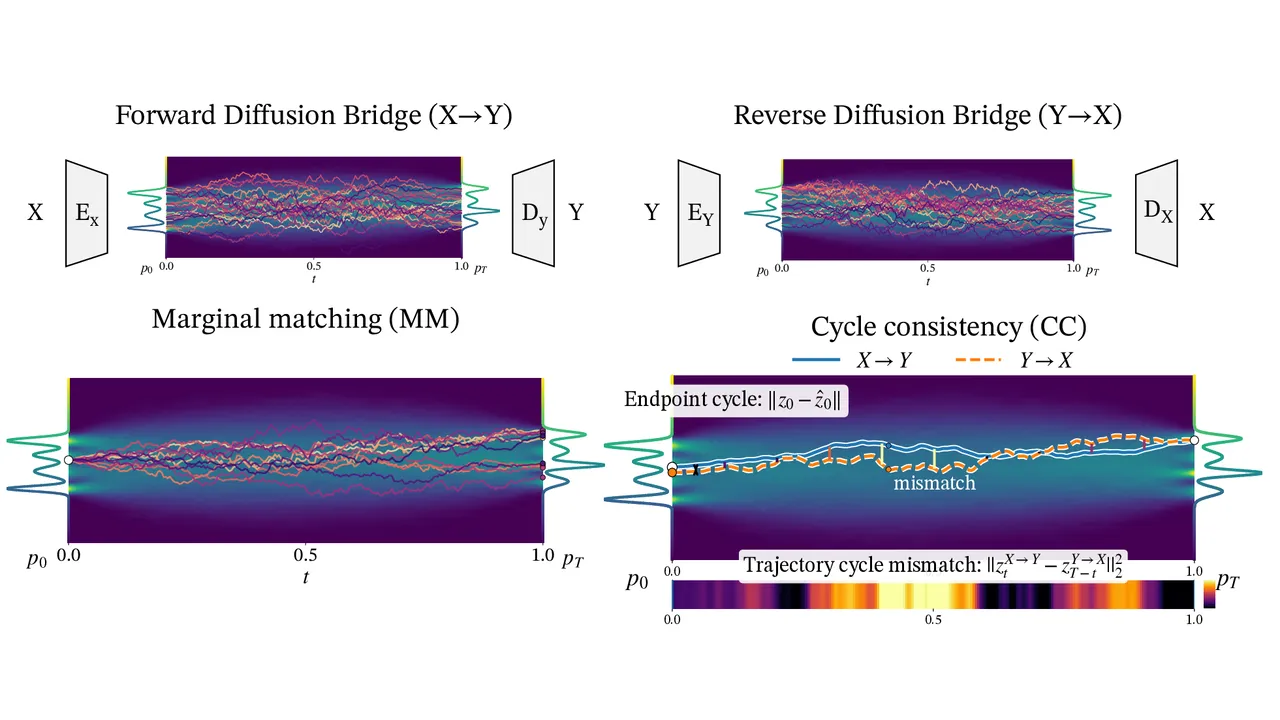
Key result
Structured Diffusion Bridges reach near fully paired quality in modality translation with half the paired data, 25.2 PSNR against 25.6 for a fully paired baseline on zero-shot super-resolution, and still learn with no pairs at all.
Abstract
Modality translation is inherently under-constrained, as multiple cross-modal mappings may yield the same marginals. Recent work has shown that diffusion bridges are effective for this task. However, most existing approaches rely on fully paired datasets, thereby imposing a single data-driven constraint. We propose a diffusion-bridge framework that characterizes the space of admissible solutions and restricts it via alignment constraints, treating paired supervision as an optional heuristic rather than a prerequisite. We validate our method on synthetic and real modality translation benchmarks across unpaired, semi-paired, and paired regimes, showing consistent performance across supervision levels. Notably, it achieves near fully-paired quality with a substantial relaxation in pairing requirements, and remaining applicable in the unpaired regime. These results highlight diffusion bridges as a flexible foundation for modality translation beyond fully paired data.
Abstract as published on OpenReview.
Cite
@inproceedings{kosman2026structured,
title={Structured Diffusion Bridges: Inductive Bias for Denoising Diffusion Bridges},
author={Eitan Kosman and Gabriele Serussi and Chaim Baskin},
booktitle={Forty-third International Conference on Machine Learning},
year={2026},
url={https://openreview.net/forum?id=nWI6lV7BvA}
}
Topics
- diffusion bridges
- modality translation
- unpaired learning
- semi-paired learning
- cycle consistency
- super-resolution
- multi-view to 3D