Understand
Long-video understanding
Benchmarks that show where Video-LLMs fail, and methods that let them look at less or train less.

I build world models that spend only the compute they need.
I'm a PhD student at Ben-Gurion University, advised by Prof. Chaim Baskin in the INSIGHT Lab, and a Research Intern at Decart, where I work on real-time video generation. Before my PhD, I earned an MSc in Computer Science at the Technion and a BSc in Computer Engineering at Sapienza University of Rome.
I'm always happy to talk about world models, efficient video models, robotics and research collaborations.


Each question forces a model to combine at least three cues from different parts of a video, and 13 Video-LLMs score only 31 to 42%.
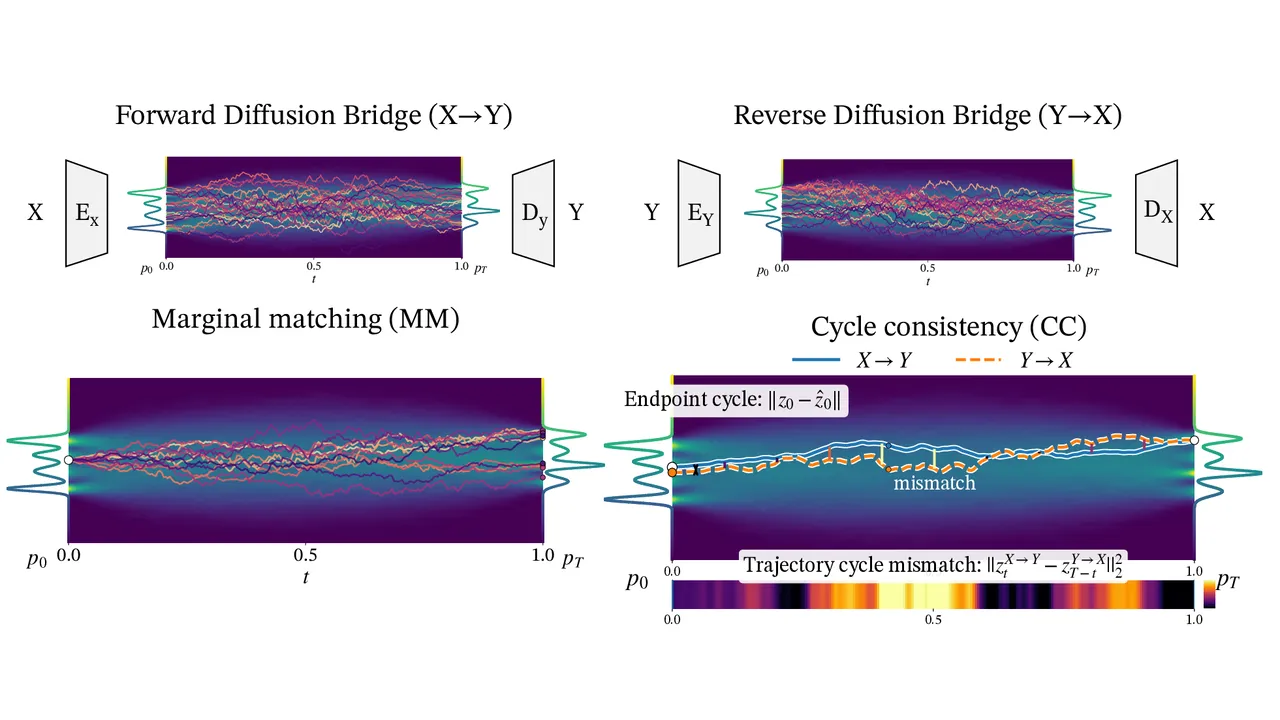
Diffusion bridges that reach near fully paired quality with half the pairs and still learn with none.
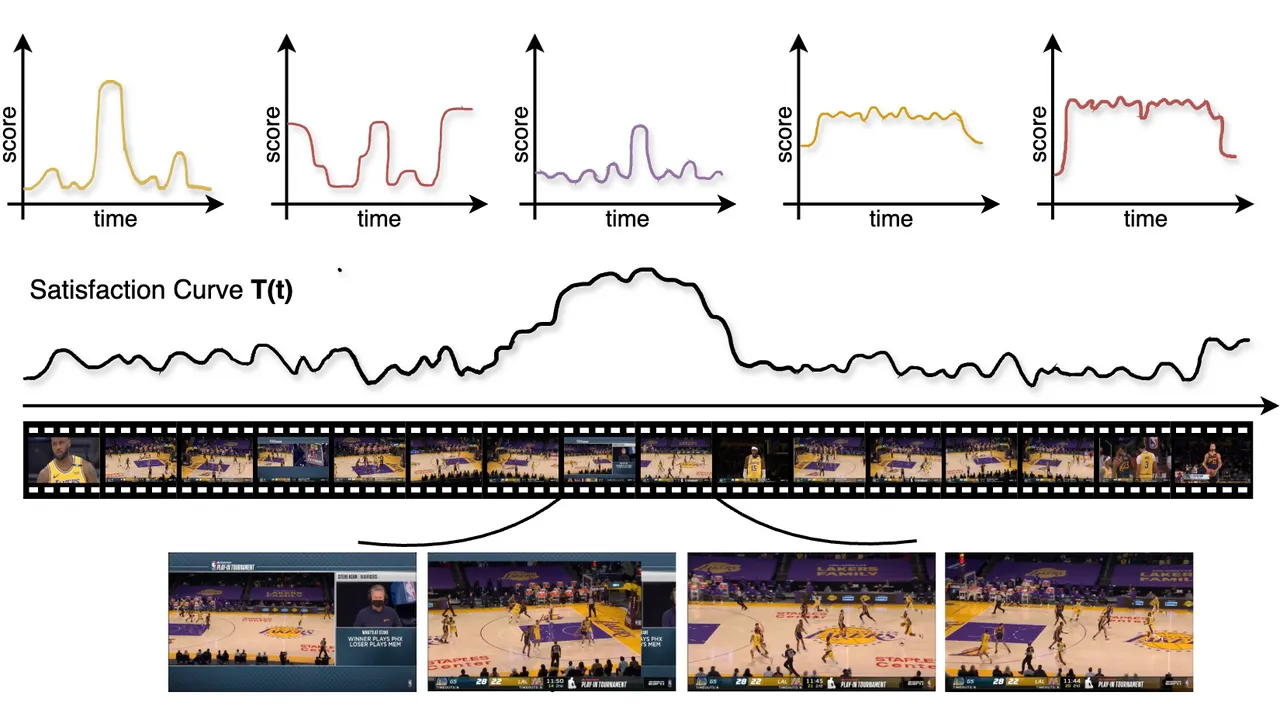
Picks 16 frames that beat 64 uniformly sampled ones on Video-MME, without any training.
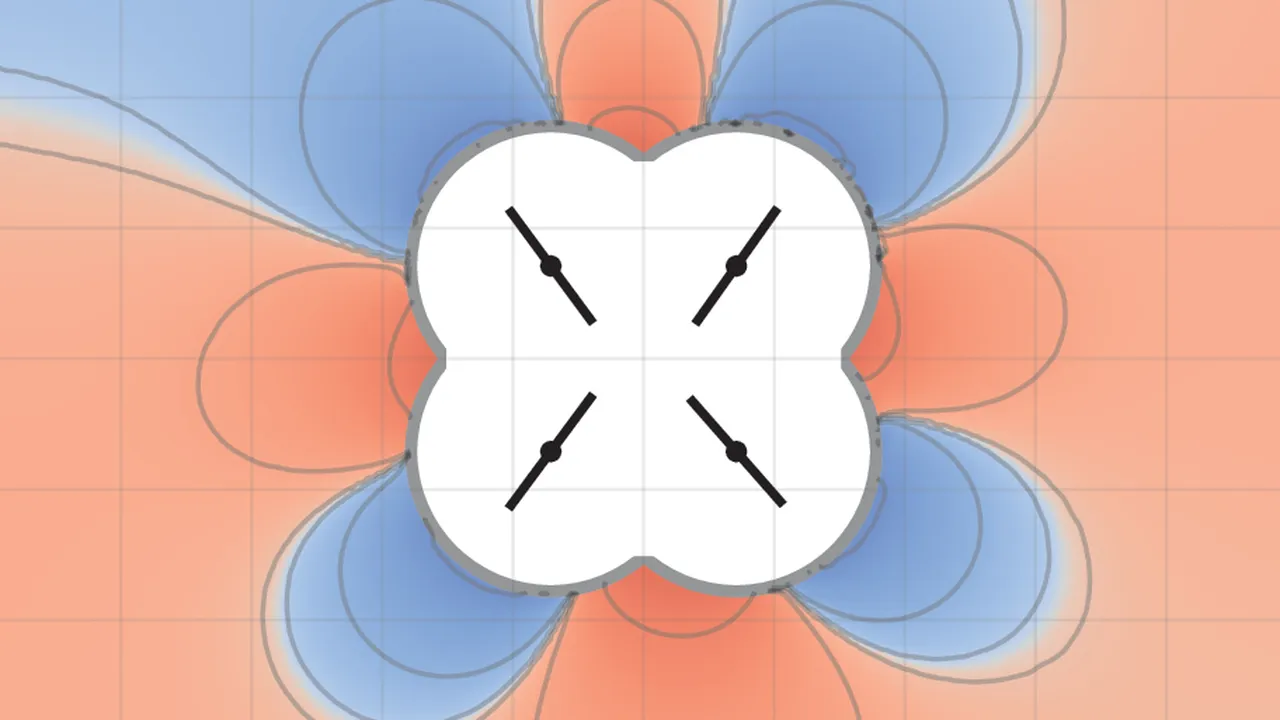
A drone that localizes itself by listening to its own rotor noise, which it learns to shape.
A useful world model has to understand, generate and act on a budget. My work covers all three, and efficiency runs through it, from what a model looks at to the hardware it runs on.
Understand
Benchmarks that show where Video-LLMs fail, and methods that let them look at less or train less.
Generate
Real-time video generation at Decart, and diffusion bridges that translate between modalities with less paired data, or none.
Act
Drones that shape their own rotor noise to localize themselves, and a growing interest in world models for robots.
In progress
Generating long videos one chunk at a time while keeping them consistent.
Distilling diffusion models into faster generators.
Helping Transformers combine many pieces of evidence, the failure HERBench exposed in Video-LLMs.
Serving large models efficiently across different kinds of hardware.
Newest direction: memory for world models, deciding what a generator or a robot should keep when it cannot keep everything.
HERBench forces video models to aggregate evidence: each of its 26,806 questions needs at least three separate cues from distinct parts of the video, and 13 state-of-the-art Video-LLMs reach only 31 to 42% (random is 20%).
@InProceedings{Ben_Ami_2026_CVPR,
    author    = {Ben Ami, Dan and Serussi, Gabriele and Cohen, Kobi and Baskin, Chaim},
    title     = {HERBench: A Benchmark for Multi-Evidence Integration in Video Question Answering},
    booktitle = {Proceedings of the IEEE/CVF Conference on Computer Vision and Pattern Recognition (CVPR)},
    month     = {June},
    year      = {2026},
    pages     = {4505-4514}
}
Structured Diffusion Bridges reach near fully paired quality in modality translation with half the paired data, 25.2 PSNR against 25.6 for a fully paired baseline on zero-shot super-resolution, and still learn with no pairs at all.
@inproceedings{kosman2026structured,
title={Structured Diffusion Bridges: Inductive Bias for Denoising Diffusion Bridges},
author={Eitan Kosman and Gabriele Serussi and Chaim Baskin},
booktitle={Forty-third International Conference on Machine Learning},
year={2026},
url={https://openreview.net/forum?id=nWI6lV7BvA}
}With 16 frames chosen by HiMu, a training-free frame selector for long-video question answering, Qwen3-VL-8B scores 73.2% on Video-MME, above its 71.7% with 64 uniformly sampled frames.
@misc{benami2026himuhierarchicalmultimodalframe,
      title={HiMu: Hierarchical Multimodal Frame Selection for Long Video Question Answering},
      author={Dan Ben-Ami and Gabriele Serussi and Kobi Cohen and Chaim Baskin},
      year={2026},
      eprint={2603.18558},
      archivePrefix={arXiv},
      primaryClass={cs.CV},
      url={https://arxiv.org/abs/2603.18558},
}Also presented at ICML 2024 Workshop (AI4Science).
Learning a drone's rotor phases together with a neural localizer lets it localize itself from its own propulsion noise, more than 2.7 times better in simulation than the best handcrafted modulation.
@inproceedings{Serussi_2024,
  title={Active propulsion noise shaping for multi-rotor aircraft localization},
  url={http://dx.doi.org/10.1109/IROS58592.2024.10802115},
  DOI={10.1109/iros58592.2024.10802115},
  booktitle={2024 IEEE/RSJ International Conference on Intelligent Robots and Systems (IROS)},
  publisher={IEEE},
  author={Serussi, Gabriele and Shor, Tamir and Hirshberg, Tom and Baskin, Chaim and Bronstein, Alex M.},
  year={2024},
  month=oct,
  pages={472--479}
}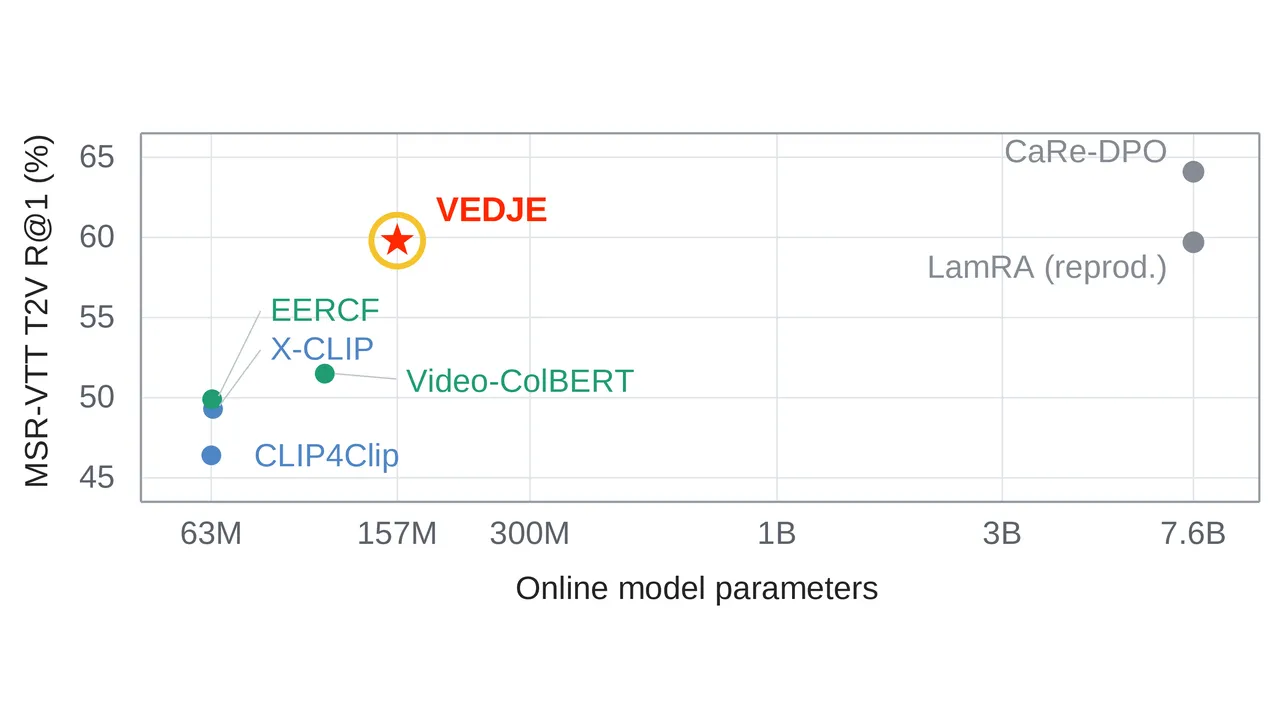
VEDJE matches a 7.6B-parameter multimodal LLM retriever on MSR-VTT text-to-video retrieval (59.8 against 59.7 R@1) with about 157M online parameters, roughly 48 times fewer, by encoding each video once into a compact cache read by a 33M-parameter reranker.
@misc{wagner2026vedjevideoefficientdiscriminativejoint,
      title={VEDJE: Video-Efficient Discriminative Joint Encoder for Scalable Video-Text Retrieval},
      author={Shahaf Wagner and Gabriele Serussi and Dan Ben Ami and Tomer Galanti and Chaim Baskin},
      year={2026},
      eprint={2610.11850},
      archivePrefix={arXiv},
      primaryClass={cs.CV},
      url={https://arxiv.org/abs/2610.11850},
}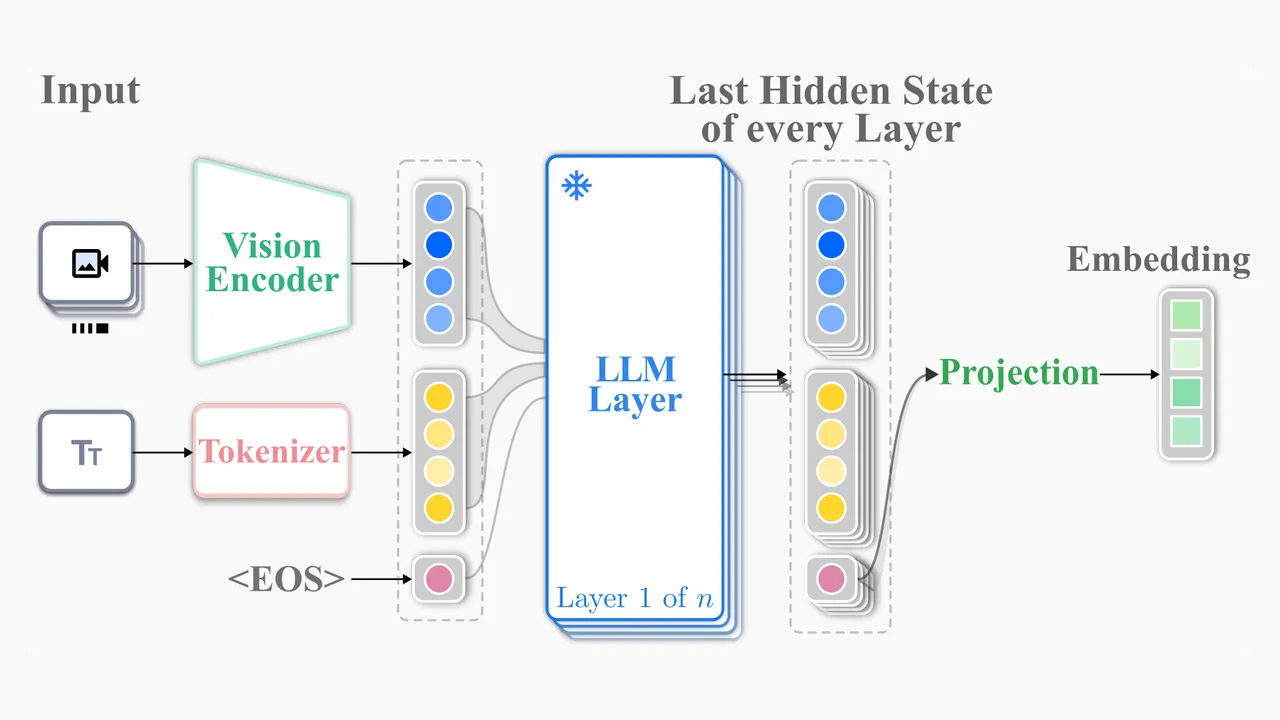
Reads a frozen VLM's hidden states to reach 99.73 Recall@1 on WebVid-CoVR, 27.23 points above the previous best.
@misc{serussi2026pregenuncoveringlatentthoughts,
      title={PREGEN: Uncovering Latent Thoughts in Composed Video Retrieval},
      author={Gabriele Serussi and David Vainshtein and Jonathan Kouchly and Dotan Di Castro and Chaim Baskin},
      year={2026},
      eprint={2601.13797},
      archivePrefix={arXiv},
      primaryClass={cs.CV},
      url={https://arxiv.org/abs/2601.13797},
}
* Equal contribution.
Research Intern, real-time video generation
2026 to present
Bosch Center for Artificial Intelligence
Research Intern, video retrieval and multimodal fusion of vision and radar, supervised by Prof. Chaim Baskin and Dotan Di Castro
2024 to 2026
Ben-Gurion University of the Negev
PhD, Electrical and Computer Engineering, INSIGHT Lab, advised by Prof. Chaim Baskin
2024 to present
Technion, Israel Institute of Technology
MSc, Computer Science, advised by Prof. Alex Bronstein and Prof. Chaim Baskin
2021 to 2024
BSc, Computer Engineering
2018 to 2021
Adversarial Evaluation and Hardening of Generative AI Trustworthiness
Research grant from Israel's Ministry of Innovation, Science and Technology, won in a competitive national call with Prof. Chaim Baskin as PI, to build methods and an open-source toolkit that find and fix the failures of generative models. I helped shape the research plan and aims, wrote major sections of the proposal and now work on the project.
2026 to 2029
I'm always happy to talk about world models, efficient video models, robotics and research collaborations.


